Free Angel Watch™ app · No app subscription · 14-day money-back guarantee
0%

China’s smartwatch suppliers are drawing attention from buyers seeking practical support for older adults. A Medication Reminder Smartwatch for Seniors should do more than vibrate at a set time. It should make the next step clear, whether that means reading a large on-screen prompt or checking a dose schedule with a caregiver. Small details matter. Can the wearer dismiss an alert without losing it? Is the charging routine manageable? Does the watch remain useful when the phone is in another room?

MIT AgeLab founder Joseph Coughlin’s work offers a relevant principle: technology for older adults should fit real routines, rather than demand extra effort. This is a paraphrase of his broader perspective, not a direct quotation. For buyers comparing China suppliers, that principle suggests asking for more than a polished product demo. Request clear specifications for reminder settings, screen readability, battery life, caregiver notifications, and data handling. Then test the watch with realistic daily schedules, including missed alerts and changes to medication times. A neat feature list is not enough.

There are limits. A smartwatch can prompt, but it cannot confirm that medicine was taken or replace guidance from a healthcare professional. And a sleek interface can still confuse someone at 7 a.m. Reliable suppliers should explain how their devices work, what they cannot do, and how updates are supported. That honesty matters. The strongest Medication Reminder Smartwatch for Seniors is not necessarily the one with the most features. It is the one an older adult can use consistently, with help available when needed.
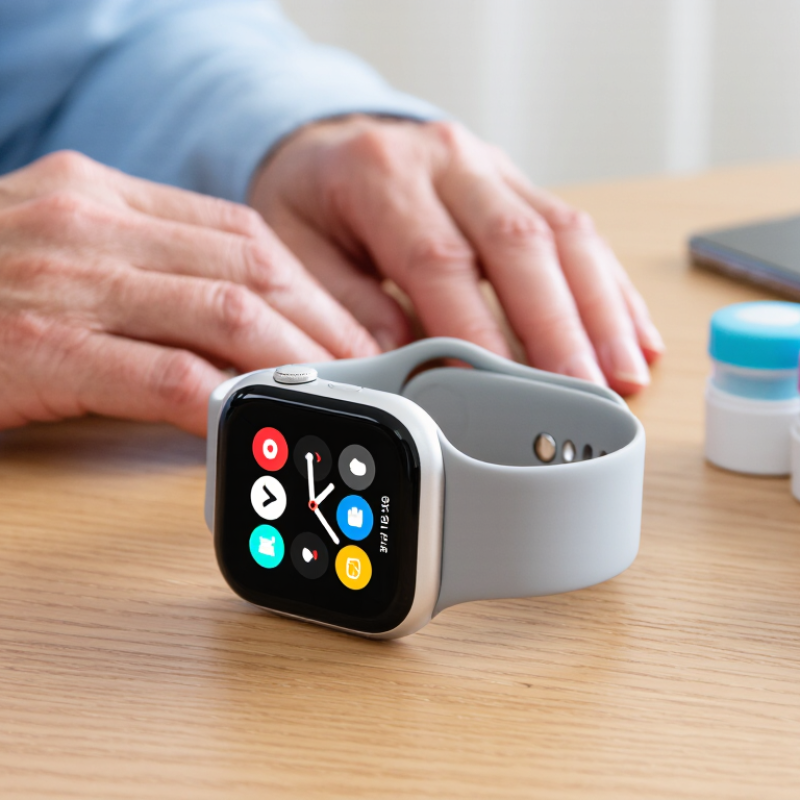
China Top Medication Reminder Smartwatch for Seniors Suppliers

What Is a Medication Reminder Smartwatch for Seniors?

A medication reminder smartwatch is a wrist-worn device that alerts an older adult when scheduled medicine is due. It may use vibration, sound, or an on-screen message, and some models let users mark an alert as acknowledged. It does not dispense medicine or confirm that a dose was swallowed. For someone with stiff fingers or reduced hearing, a large display and strong vibration may be more useful than a long list of features. Small details matter. A reminder can still be missed.

The need is growing: the UN Department of Economic and Social Affairs projected that 1.6 billion people would be aged 65 or older by 2050. The World Health Organization has estimated that medication errors cost about US$42 billion each year. A smartwatch cannot prevent every error, but timed prompts may help make routines more visible. Families and clinicians should check whether its alerts match the prescribed schedule and the wearer’s abilities. A missed confirmation is not proof that medicine was missed—or taken. That uncertainty deserves attention.

How Medication Reminders Work on Senior Smartwatches

Medication reminders on a senior smartwatch turn a written schedule into timed prompts on the wrist. A user or caregiver can enter the medicine name, dose, and planned time through the watch or its paired phone, depending on the model. At 8 a.m., the screen might show “morning tablet,” while a gentle vibration helps when the room is noisy. Some devices also use sound or repeat alerts.

After the prompt, the wearer may tap a button to mark it as taken or dismiss it. That record can help users notice missed prompts, though it cannot prove that a dose was swallowed. Reminder settings should match the clinician’s instructions and the prescription label. Changing timing or dose based only on a watch alert is not appropriate. Families should check who can view records and whether the watch needs a phone connection.

A reliable setup starts with one clear reminder and a test alarm. Check the time, vibration strength, battery level, and quiet-hour settings. Then review the schedule after travel or a daylight-saving change. Small errors happen. The interface may also be hard to read for someone with low vision, so larger text and a simple alert pattern matter. The watch supports a routine; it does not replace personal medical advice.

Key Features for Safety, Comfort, and Ease of Use

For older adults, a medication reminder smartwatch should make the next step obvious, not add another task. A clear, high-contrast display helps users read an alert under kitchen lighting or outdoors. Large text and simple menus matter. Vibration can help in a noisy room, while an adjustable tone may suit quieter settings. Let users choose both.

Safety depends on reminders that are dependable and easy to check. The watch should display the medicine name and scheduled time, and show whether an alert was acknowledged when that feature is available. Caregivers may value optional alert sharing, but privacy settings and straightforward pairing need equal attention. No reminder system is perfect. A missed tap, low battery, or incorrect schedule can still cause confusion. The watch supports a care plan; it does not replace guidance from a clinician or pharmacist.

Comfort affects whether the device stays on the wrist. A lightweight case, soft adjustable band, and accessible charging dock can reduce daily friction, especially for people with stiff fingers. Water resistance may help with handwashing, but users should check its stated limits. Suppliers should explain battery life, software support, warranty terms, and schedule setup. Ask for a real demonstration. A feature list alone is not enough. Some menus still feel fiddly, so testing with older users before purchase is worthwhile.

How to Evaluate Chinese Smartwatch Suppliers

China Top Medication Reminder Smartwatch for Seniors Suppliers

How to Evaluate Chinese Smartwatch Suppliers

When evaluating Chinese smartwatch suppliers, ask how they verify medication reminders, screen readability, and battery performance. Request a working sample, not only a product sheet. Set reminders for morning and evening, then check whether alerts are clear in a bright room and easy to dismiss with less steady fingers. Small details matter. Ask for test records and consistent quality checks across production batches.

Tips: Test the watch with an older adult. Check speaker volume, vibration strength, font size, charging ease, and setup steps. Test it offline. Ask what happens after a missed alert or a drained battery, and confirm whether reminder schedules remain saved.

Review the supplier’s communication and after-sales process, too. Request written warranty terms, replacement procedures, and realistic production timelines. Ask how user data is stored and who can access it. A polished sample does not guarantee every production unit will behave the same way. That concern is worth discussing before placing an order. Keep notes from sample testing and compare them with the supplier’s written specifications.

Sourcing and Verifying a Suitable Supplier in China

China’s ageing population makes supplier selection more than a price comparison. China’s National Bureau of Statistics reported 296.97 million residents aged 60 or above at the end of 2023. The World Health Organization projects that one in six people worldwide will be aged 60 or older by 2030. These figures signal growing need, but they do not prove that any supplier can deliver a dependable product.

Request a production sample, factory details, and quality records before discussing large orders. Check whether reminder schedules are easy to set, alarms remain audible, and missed alerts are clearly shown. Test the watch on a small wrist and with older users in ordinary lighting. Test it yourself. Ask for battery-life results under stated settings, not just a best-case figure. Review certificates directly with the issuing body and confirm that they cover the actual factory and product scope.

Compare test reports with the exact model and components offered. Ask how the supplier tracks batches, handles defects, and controls changes to parts or software. A neat sample can still hide a weak process. I would also question whether the screen is genuinely readable; specifications alone can make this unclear. Don’t treat medication reminders as proof of medical accuracy. Request written limits on performance and a clear after-sales process before agreeing to production terms.

China Top Medication Reminder Smartwatch for Seniors Suppliers - Sourcing and Verifying a Suitable Supplier in China

Evaluation area What to verify Evidence to request Practical sourcing check
Supplier identity and capability Confirm the legal business entity, factory or trading role, product experience, and which production steps are outsourced. Business registration details, factory address, product catalog, production-flow overview, and a live video walkthrough of relevant facilities. Match the contracting entity, invoice details, and factory information. Ask who is responsible for assembly, testing, and after-sales service.
Medication reminder function Check how reminders are scheduled, repeated, snoozed, acknowledged, and synchronized after a time-zone or daylight-saving change. Feature specification, user manual, app demonstration, and test results for reminder behavior when the watch is disconnected from the phone. Test recurring schedules, missed-alert handling, low-battery behavior, and recovery after restart. Confirm that an alert is not presented as proof that medication was taken.
Senior-friendly usability Assess screen readability, touch-target size, alert volume or vibration, menu complexity, strap fit, and charging ease. Unedited product photos, interface screenshots, user instructions, and a physical sample for hands-on evaluation. Ask older adults to complete common tasks, such as acknowledging a reminder and charging the device. Record completion issues and revise requirements before production.
Battery and charging Verify battery capacity, typical-use runtime, charging time, charger type, and behavior when battery power is low. Battery specification, runtime test conditions, charging instructions, and applicable battery transport test documentation, including UN 38.3 for lithium batteries shipped by air or other regulated transport. Compare the supplier's runtime claim with a sample test using your intended reminder frequency, screen settings, and connectivity conditions.
Connectivity and app support Confirm supported phone operating systems, Bluetooth behavior, app languages, account requirements, and the process for software updates. Compatibility matrix, pairing instructions, app test access, update policy, and Bluetooth qualification information where applicable. Pair samples with the phone models and operating-system versions your customers use. Test reconnection, notifications, and app availability in target markets.
Privacy and data handling Determine what medication, account, and device data are collected, where they are stored, who can access them, and how users can delete accounts or data. Privacy policy, data-flow description, access-control overview, retention and deletion procedures, and details of third-party services used by the app. Check requirements for each sales region. For EU personal data, assess GDPR obligations; avoid assuming that a device is compliant based only on a supplier's verbal assurance.
Product compliance and claims Identify the intended use and claims for each market. A reminder feature alone does not establish that a product is a medical device. Applicable test reports, declarations, labeling, and technical documents for the exact model and configuration. For medical-device claims, request evidence relevant to the destination market's regulatory pathway. Verify documents with the issuing body or laboratory where possible. CE marking, FDA establishment registration, and FDA device authorization are not interchangeable; registration alone does not mean FDA approval.
Durability and water resistance Check case, strap, button, screen, and charging-contact durability, plus the stated water-resistance level and its limitations. Relevant test reports, test conditions, material specifications, and care instructions. Water-ingress ratings should be supported by testing such as IEC 60529 where applicable. Confirm whether the product is suitable only for splashes or for another stated use. Do not infer swimming or shower suitability from a rating without checking the manufacturer's defined conditions.
Quality control and traceability Review incoming-component checks, assembly controls, functional testing, defect handling, and serial or batch traceability. Quality procedures, sample inspection records, a defect-correction process, and any relevant quality-management certificates with their scope and validity. Agree written acceptance criteria before production. Use a pre-shipment inspection and verify that the inspection sample represents the final production configuration.
Commercial terms and support Clarify minimum order quantity, sample and tooling costs, lead time, payment milestones, warranty, spare parts, and response process for defects. Itemized quotation, written specification, approved sample record, production schedule, warranty terms, and proposed packaging details. Compare like-for-like specifications and Incoterms. Put approved changes, delivery requirements, and defect remedies in the purchase agreement.
Recommended verification sequence Screen documents first, evaluate a sample, confirm requirements and claims, then verify production before shipment. Document review, sample evaluation notes, signed specification, production inspection report, and shipping documents. Treat the checks in this table as a buyer's evaluation framework, not as a substitute for independent testing or market-specific legal advice.

FAQS

What does a medication reminder smartwatch do?

It alerts the wearer when a scheduled dose is due, using vibration, sound, or an on-screen message. It does not dispense medicine or confirm that a dose was swallowed.

Can a smartwatch prevent missed doses?

Timed prompts can make daily routines more visible, but they cannot prevent every mistake. A missed tap does not prove whether medicine was taken. That part remains uncertain.

Which features can make alerts easier to notice?

Look for large, high-contrast text, a clear medicine name, and the scheduled time. Strong vibration can help in a noisy kitchen. Adjustable sound matters too.

Can a caregiver check whether an alert was acknowledged?

Some watches show whether an alert was acknowledged or offer optional alert sharing. Check privacy settings and pairing steps. An acknowledgment still does not confirm a dose was taken.

What should older adults consider for comfort?

A lightweight case, soft adjustable band, and accessible charging dock can make daily use easier. Test the clasp with stiff fingers. Some menus still feel fiddly.

How should battery life and reminder schedules be checked?

Ask for battery results under specific settings, then test the schedule yourself. Confirm the watch displays missed alerts clearly. Small details matter.

How can a supplier in China be evaluated?

Request a production sample, factory details, and quality records before discussing a large order. Verify certificates with the issuing body and check that they cover the actual product and factory.

What should be tested before placing a large order?

Try the watch on a small wrist and in ordinary indoor lighting. Check alarm audibility, schedule setup, and battery performance. A polished sample alone is not enough.

Conclusion

A Medication Reminder Smartwatch for Seniors is a wearable device designed to help older adults keep track of scheduled doses and daily routines. Reminders may appear as clear on-screen alerts, vibrations, or audible prompts, allowing users to check a notification and mark a dose as taken. Depending on the device, caregivers may also be able to review reminders or receive updates, while the watch’s interface should remain simple and easy to understand.

When choosing a smartwatch, consider more than reminder functions. A comfortable fit, readable display, straightforward controls, dependable battery life, and useful safety features can all affect everyday use. Buyers evaluating Chinese suppliers should compare product specifications, customization options, communication, quality-control processes, and sample availability. Before placing an order, verify the supplier’s business information, inspect samples, clarify testing and warranty terms, and confirm production and shipping details. Careful checks can help identify a suitable supplier and ensure the product matches the intended users’ needs.


Amelia

Amelia

Amelia is a professional marketing specialist dedicated to helping businesses understand the value, performance, and practical applications of our company’s products. With a strong background in market research, content strategy, and customer communication, she combines commercial insight with......