Parents seeking a child’s first connected device often want reliable contact without endless scrolling. A Social Media Free Kids Cell Phone Watch can offer calling, location features, and simple controls in a wrist-worn design. For buyers comparing China-based suppliers, the product page is only a starting point. Real differences appear in call clarity, location updates, battery life, and how comfortably the watch fits a small wrist.
This introduction outlines what to examine when evaluating manufacturers and their product ranges. Check whether the watch supports the mobile networks used in your target market, and ask how its companion app handles account access and location data. Request a working sample, not just polished photographs. Test the buttons, charging connection, strap clasp, and signal in ordinary places, such as a school entrance or a busy apartment building. Ask for current test reports and clear warranty terms, then verify documents with the issuing organization where practical. Details matter.
Supplier claims deserve careful review. GPS can be less precise indoors, and battery performance may change with frequent calls or location checks. A watch without social media still needs thoughtful supervision and clear family rules. No device replaces a conversation. This guide helps buyers compare specifications, communication, customization, and after-sales support without assuming every supplier offers the same quality. Some trade-offs remain, and that is worth acknowledging before a purchase.
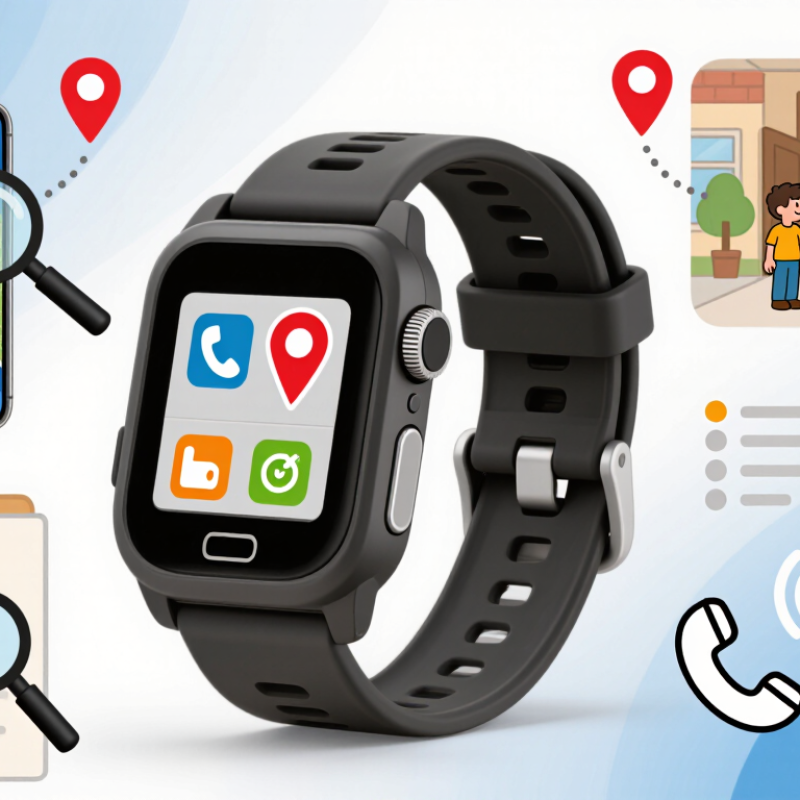
What Defines a Social-Media-Free Kids’ Cell Phone Watch?
A social-media-free kids’ cell phone watch supports contact without turning a child’s wrist into a scrolling feed. It should have no public profile, follower system, short-video stream, or recommendation algorithm. No endless feed. Calls and messages can remain available, with approved contacts managed by a caregiver. A simple screen showing a family message feels different from a stream designed to keep users tapping. The distinction depends on software, not the watch’s size or appearance. Buyers should check whether social apps can be installed later, and whether a web browser bypasses the limits.
The Common Sense Census: Media Use by Tweens and Teens, published by Common Sense Media in 2021, reported average daily entertainment screen use of 5 hours 33 minutes for U.S. children aged 8–12. For teens, it reported 8 hours 39 minutes. These figures cover many kinds of media, not watches alone, so they do not prove that a phone watch reduces screen time. They do show why clear boundaries matter. Look for caregiver-controlled contacts, visible call controls, and location sharing that can be switched off when unneeded. Small details count. I would still ask how the device handles software updates; “social-media-free” can become less clear over time.
Use these criteria to assess supplier claims. “Social-media-free” describes the device’s available software and controls; confirm the exact functions on the model and firmware being offered. This table is an evaluation guide, not a supplier ranking.
| Evaluation Dimension | What Defines a Social-Media-Free Watch | How to Verify with a Supplier | Practical Acceptance Check |
|---|---|---|---|
| Social-media access | The watch does not provide social-networking apps, social feeds, or a general-purpose browser for accessing social-media services. | Request a live device demonstration and a list of preinstalled apps and supported software features. | Confirm there is no social-media app, feed, or unrestricted web-browsing feature in the tested configuration. |
| App installation | Children cannot freely install additional apps that could introduce social networking or other unsuitable services. | Ask whether the operating system includes an app store, sideloading, or administrator-controlled installation. Test the parent controls. | Verify that app installation is unavailable or restricted to an authorized parent or administrator. |
| Calling and messaging | Communication is limited to the functions offered by the model, such as calls or messages with approved contacts; it is not equivalent to social networking. | Check supported communication types, contact approval settings, SIM requirements, and whether calls or messages depend on mobile-network coverage. | Test incoming and outgoing communication with approved contacts. Confirm that service availability depends on the selected network and plan. |
| Contact controls | A parent or guardian can manage who may contact the child, where the model supports contact management. | Request a demonstration of adding, editing, and removing contacts, and ask whether unknown callers can be blocked. | Verify the controls on the actual watch and its companion app; do not rely solely on a feature list. |
| Location functions | Location tracking is a separate safety feature and does not itself make a watch social-media-enabled. | Ask which positioning methods are supported and what connectivity is needed to send location data to a parent’s device. | Confirm the model’s location features, update behavior, and limitations indoors or where satellite or network signals are weak. |
| SOS and emergency features | An SOS button or alert may contact configured numbers or services, depending on the model and its network setup. | Request a demonstration and documentation describing the alert flow, required settings, and connectivity conditions. | Test the feature using the supplier’s safe test procedure. Confirm that it is not represented as a substitute for emergency services. |
| Parental management | Parent controls may cover contacts, usage settings, or selected features; the available controls vary by model. | Review the companion app or management interface and ask which settings are controlled locally versus remotely. | Check that controls work on the production model and that account setup, permissions, and reset procedures are documented. |
| Privacy and data handling | Location, account, and communication data may be processed to provide connected features. “Social-media-free” does not mean “data-free.” | Request the privacy notice, data-flow details, retention information, and an explanation of any cloud services or third-party processors. | Review what data is collected, why it is needed, where it is handled, and how a parent can delete an account or request deletion. |
| Connectivity and compatibility | Calling, messaging, and remote features may require a compatible cellular network, SIM or eSIM service, and a paired phone. | Request supported network bands, SIM specifications, companion-app requirements, and the target-market compatibility information. | Check compatibility with the intended country, carrier, phone operating system, and service plan before placing an order. |
| Battery and charging | Battery life depends on usage, signal conditions, enabled features, and battery capacity; supplier estimates should be tested under stated conditions. | Ask for battery capacity, charging specifications, and the test conditions behind any runtime claim. | Compare samples using the same calling, location, screen, and standby pattern rather than relying on an unspecified headline figure. |
| Product safety and market compliance | Applicable safety, radio, and chemical requirements depend on the destination market and the product configuration. | Request current test reports and declarations for the exact model and target market; verify report scope and issuing laboratory. | Confirm that documentation covers the supplied model, radio configuration, accessories, and destination-market requirements. |
| Supplier quality and production control | A supplier should be able to explain how samples, firmware, component changes, and production batches are controlled. | Ask for a production sample, quality-control process, change-notification policy, warranty terms, and defect-handling procedure. | Compare the approved sample and software with the order specification, and document required features and acceptance tests in writing. |
Ask who designs, assembles, and sells the watch. Request a production sample, component list, and recent test reports. Paperwork helps, but it is not proof.
Check GPS outdoors and near tall buildings. Test calls in a noisy room, then measure battery life with location updates enabled. Small details matter.
Inspect the strap edges, buckle, screen, charging contacts, and case seams. Try the screen with damp fingers. Look for loose or sharp parts.
Ask where data is stored, who can access it, and how long it is retained. Get clear written answers. Vague replies deserve follow-up.
Request the supported cellular network bands for that market. A cellular label alone says little.
Write acceptance criteria for screen defects, button response, charging, call clarity, and carton condition. Ask how failed units are recorded and corrected.
No. A sample may not match later batches. Compare it with the planned production line and consider independent random-unit inspection. Even careful checks miss things.
Review warranty terms, spare-part availability, software-update commitments, response times, and defect handling. Price is only one signal. I still find batch consistency hard to judge.
A Social Media Free Kids Cell Phone Watch is designed to keep children connected with family without the distractions of social networking. This overview explains what sets these watches apart and highlights practical features such as calling, location sharing, emergency contacts, parental controls, and durable, child-friendly construction. It also considers how device design and clear privacy settings can support safer, more age-appropriate communication.
The article surveys China’s kids’ watch supplier landscape and offers a practical framework for comparing potential suppliers. Buyers can assess product specifications, communication performance, materials, battery life, manufacturing capabilities, customization options, and responsiveness. It also outlines sourcing and quality checks, including reviewing samples, verifying stated features, inspecting workmanship, and confirming packaging and support requirements before placing an order.